Retained technical leadership
Architecture, roadmap decisions, security review, vendor judgment, and hands-on delivery without building a full internal technology department first.
Fractional CTO · delivery leadership · technical diligence
Ask the Human · Bert Carroll
Most of the people I work with have an operation in motion. Their software no longer fits, or the vendor behind it is too slow, expensive, or unresponsive to make the changes they need. I help close that gap with custom software they can own and change.
Start
The operating problem
Agree
Requirements and acceptance
Price
Clear scope before work begins
Deliver
Visible state and evidence
How I work
The right questions expose what the business actually needs. Making the consequential choices concrete gives everyone a chance to correct assumptions before they become expensive commitments.
I listen past the first request to understand who uses the system, what they decide, and what needs to be true.
Key workflows and decisions become concrete early enough for the people who know the business to challenge them.
Requirements carry clear acceptance criteria so the result can be demonstrated and accepted without moving the goalposts.
Scope, decisions, risks, progress, and delivery evidence stay visible while there is still time to act on them.
Commercial clarity
Some clients are founders ready to fund a first build. Most new relationships start with one focused project, priced before work begins. Clients often expand the work once they have seen what I can do. For continuing priorities, a retainer keeps the same acceptance discipline and visible record in place as the work changes.
Where this tends to lead
Healthcare is the center of gravity. I also work in education, HR and HCM, crypto, and other domains when the problem fits.
Architecture, roadmap decisions, security review, vendor judgment, and hands-on delivery without building a full internal technology department first.
Fractional CTO · delivery leadership · technical diligence
New operational software, inherited codebases, integrations, and projects that have become too consequential to leave half-working.
Healthcare workflows · internal platforms · production recovery
Data and document movement between systems, including the mapping, validation, reconciliation, and cutover discipline the word migration tends to hide.
HCM and payroll · operational data · system replacement
Senior judgment on a specific software problem, followed by a practical decision and a build when building is the right answer.
Technical diagnosis · advisory · scoped delivery
Selected delivery evidence
Regulated care delivery
Clinical documentation, billing, review, and staff knowledge translated into traceable requirements, executable UAT, and named acceptance.
Inside the record: A representative requirement, acceptance criteria, UAT walkthrough, and delivery receipt.
Healthcare marketplace
Consumer intake, payments, operators, clinical partners, fulfillment, and changing vendor contracts kept coherent through visible handoffs and acceptance gates.
Inside the record: A representative requirement, acceptance criteria, UAT walkthrough, and delivery receipt.
HCM migrations
Extraction, normalization, document handling, QA, and cutover support shaped into a reusable delivery model for partner-led payroll transitions.
Summary only No public record
Transparent delivery
You can see what has been decided, what remains open, how acceptance is defined, and what has actually shipped.
Agreed scope
What we are doing, why it matters, and what is outside the current commitment.
Acceptance
What must be true for the work to be demonstrated and accepted.
Current state
What is complete, in progress, blocked, or waiting on a decision.
Delivery evidence
What has been shown, accepted, and put into use.
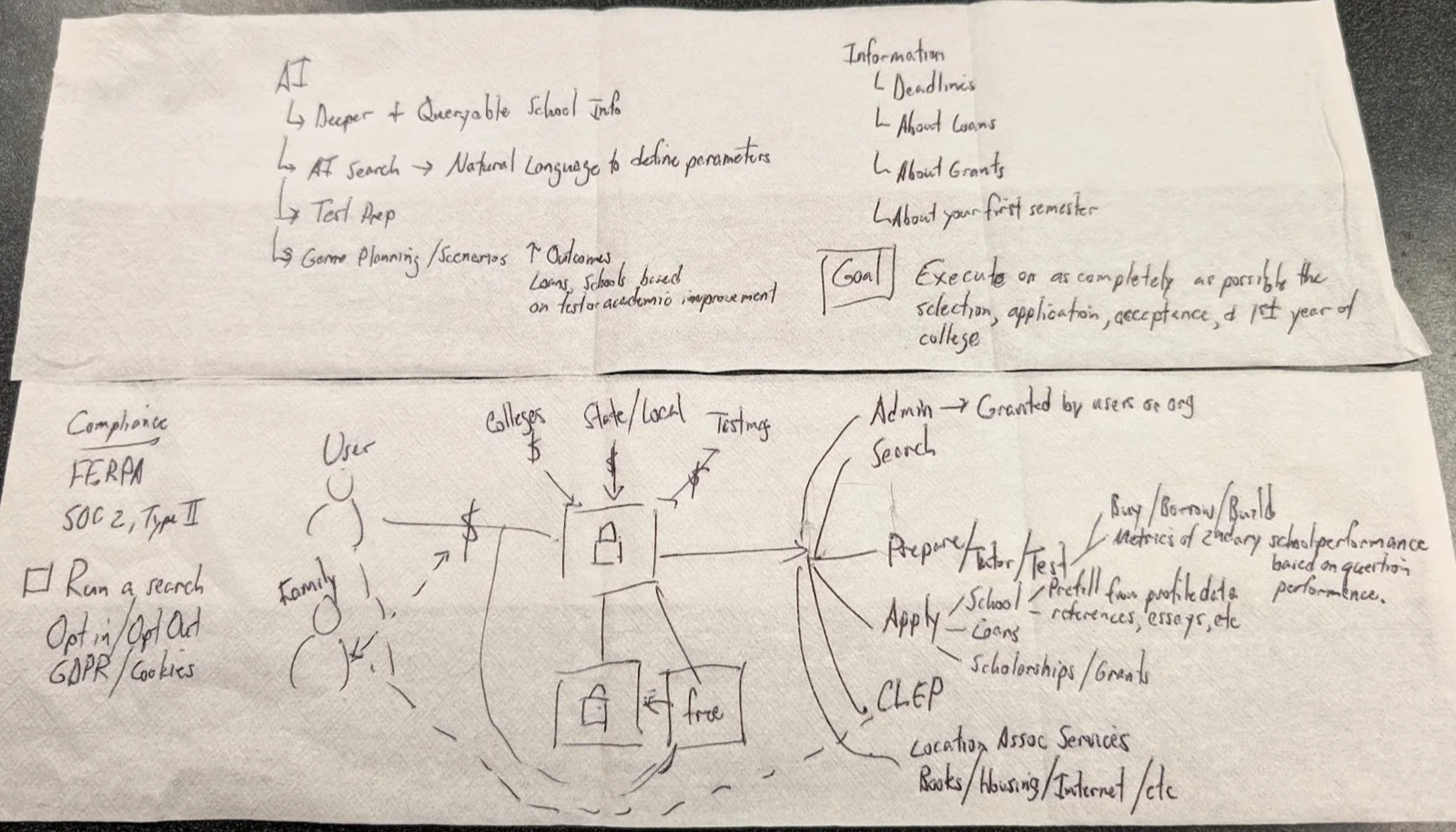
The original Waffle House napkin · October 2025
Why Napkin Sessions exist
A conversation about college planning became this sketch, then a working platform. Once we could point to something real, the right questions and decisions came faster. That is the spirit behind the name.
A Napkin Session starts with a short submission. I review the context and reply with the most useful next step. If I am not the right fit, I will say so and may refer you elsewhere.
Submit a problem for review
Bert Carroll · Principal
Twenty years across business analysis, project delivery, product decisions, and software implementation means I can move between the boardroom version of a problem and the production version without a handoff.
You bring domain knowledge I could not develop on my own. I bring patience, questions, and patterns learned across many systems. We make the problem tangible early and turn what we learn into accepted work.
Ask the Human is literal. The first request is rarely the whole problem. My job is to find the right questions, then show what the answers mean in working form.
One body of work
Start with context